Get the book
The same content as the creativity course in a 250-page paperback book format. For those who prefer a physical book to a digital environment. Price does not include shipping.
Book - $50.000 CLP →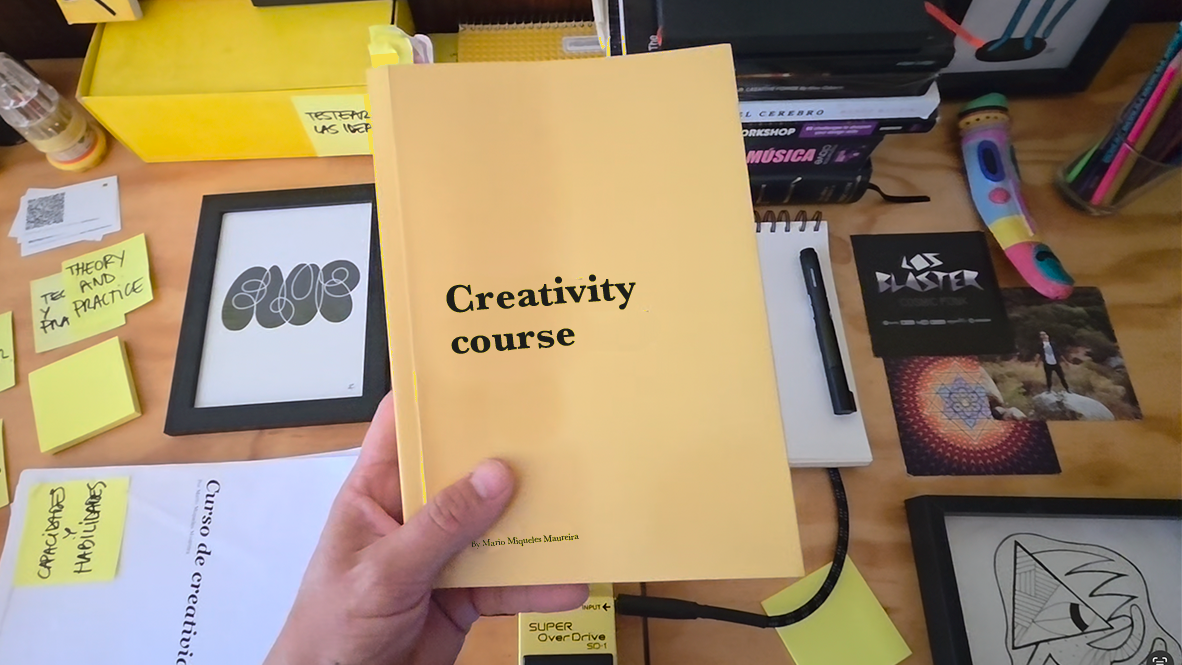
Study on line
Subscription to the online version of the creativity course. Pay only once and study whenever you want. Unlimited access to the course through the virtual classroom of the "Master in Creativity" program.
Subscription - $50.000 CLP →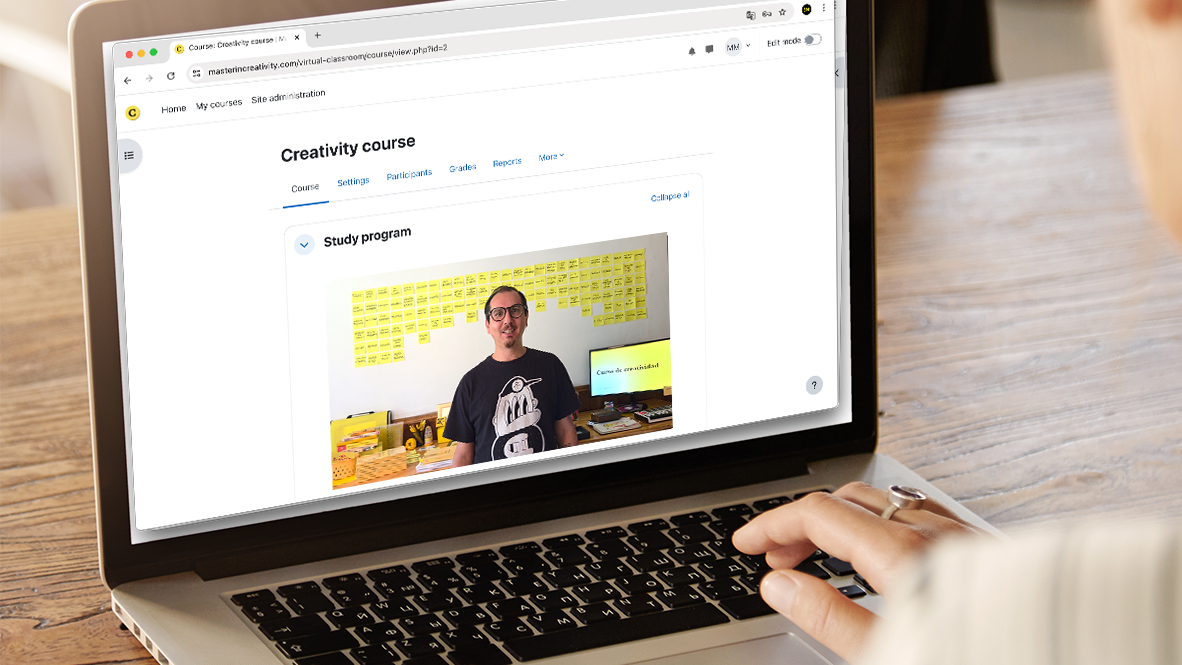
Many people believe that creativity is a talent reserved for a select few. This course starts from a different premise, creativity is a skill that can be learned.
Here you will find a clear and structured explanation of how creative thinking works, along with practical exercises that you can apply in your life, at work, or in the classroom. This isn't an inspirational course; it's a method for understanding and developing creativity in a serious and professional way.
Course summary
Author
Mario Miqueles Maureira - Designer. Master in higher education
mario.miqueles@masterincreativity.com
Student profile
This course is designed for educators, teachers, and individuals who want to understand creativity in a deep, practical, and structured way, in order to develop it in themselves and teach it to others. It is also intended for those who have at some point doubted their own creative capacity or feel that they “are not creative,” but are motivated to learn and explore new ways of thinking.
Through an accessible and progressive approach, the course provides clear theoretical foundations along with concrete tools that make it possible to understand how creativity works, how it can be trained, and how it can be applied in educational, professional, and personal contexts, without requiring prior training in the field.
Competency to be acquired
Use creativity consciously and methodically to generate innovative ideas and/or possible solutions to problems at any time.
Study units
- 1. Introduction to creativity
- 2. Creative thinking techniques
- 3. Creative techniques for problem solving
- 4. Tools for idea generation
- 5. Final project
Modality
Self-learning, asynchronous.
Estimated duration
20 weeks (120 hours).
The estimated duration is with an approximate dedication of 6 hours per week according to the details suggested in the study program.
Learning methodology
- 1. Reading bibliography (2 hours per week)
- 2. Developing practical exercises (3 hours per week)
- 3. Self-assessments (1 hour per week)
Bibliography
- Alessandroni, N. (2017). Imaginación, creatividad y fantasía en Lev S. Vygotski: una aproximación a su enfoque sociocultural. Actualidades en Psicología, 31(122), 45–60.
- Almeida, L. S., Prieto, L. P., Ferrando, M., Oliveira, E., & Ferrándiz, C. (2008). Torrance Test of Creative Thinking: The question of its construct validity. Thinking Skills and Creativity, 3(1), 53–58.
- Altshuller, G. (1999). The innovation algorithm: TRIZ, systematic innovation, and technical creativity. Worcester, MA: Technical Innovation Center.
- Amabile, T. M. (1983). The social psychology of creativity: A componential conceptualization. Journal of Personality and Social Psychology, 45(2), 357–376.
- Amabile, T. M. (1996). Creativity in Context. Westview Press.
- Amabile, T. M. (2012). Componential theory of creativity (Working Paper No. 12-096). Harvard Business School.
- Arnheim, R. (1969). Visual Thinking. University of California Press.
- Basadur, M. S., Runco, M. A., & Vega, L. A. (2000). Understanding how creative thinking skills, attitudes and behaviors work together: A causal process model. The Journal of Creative Behavior, 34(2), 77–100.
- Basadur, M., & Gelade, G. A. (2005). The role of knowledge management in the innovation process. Creativity and Innovation Management, 14(1), 45–62.
- Basadur, M., Basadur, T., & Calic, G. (n.d.). Organizational development. In Handbook of Organizational Creativity. Manuscript.
- Basadur, M., Basadur, T., & Gelade, G. (2013). Simplexity thinking. En E. G. Carayannis (Ed.), Encyclopedia of Creativity, Invention, Innovation and Entrepreneurship. Springer.
- Basadur, M., Gelade, G., & Basadur, T. (2014). Creative problem solving process styles, cognitive work demands, and organizational adaptability. Journal of Applied Behavioral Science, 50(1), 80–115.
- Boden, M. A. (2004). The creative mind: Myths and mechanisms (2nd ed.). Routledge.
- Bonnardel, N., & Didier, J. (2020). Brainstorming variants to favor creative design. Applied Ergonomics, 83, 102987.
- Brown, T. (2009). Change by Design: How Design Thinking Creates New Alternatives for Business and Society. Harvard Business Press.
- Buzan, T. (2004). Cómo crear mapas mentales. Ediciones Urano.
- Buzan, T. (2006). The ultimate book of mind maps. Thorsons.
- Byron, K. (2012). Creative reflections on brainstorming. London Review of Education, 10(2), 201–213.
- Cabrera Cuevas, J. (2018). Epistemología de la creatividad desde un enfoque de complejidad. Educación y Humanismo, 20(35), 114–128.
- Cropley, D. H. (2015). Creativity in engineering. En G. E. Corazza & S. Agnoli (Eds.), Multidisciplinary contributions to the science of creative thinking (pp. 155–173). Springer.
- Cropley, A. J. (2015). Promoting Creativity in Engineering Students. In D. D. Williams (Ed.), Exploring Innovation in Education and Using the iPad (pp. 53–71). University of Latvia Press.
- Cropley, D. H., & Patston, T. J. (2019). Supporting creative teaching and learning in the classroom: Myths, models, and measures. En C. A. Mullen (Ed.), Creativity Under Duress in Education? (pp. 267–288). Springer.
- Csikszentmihalyi, M. (1996). Creativity: Flow and the psychology of discovery and invention. HarperCollins.
- Csikszentmihalyi, M. (1998). Fluir (Flow): Una psicología de la felicidad. Barcelona: Editorial Kairós.
- de Barros, R., Resende, L. M., & Pontes, J. (2025). Exploring creativity and innovation in organizational contexts. Journal of Open Innovation, 11, 100526.
- De Bono, E. (1990). Lateral thinking: A textbook of creativity. Penguin Books.
- De Bono, E. (1986). Six thinking hats. Viking.
- De Bono, E. (1992). Serious Creativity: Using the Power of Lateral Thinking to Create New Ideas. HarperBusiness.
- Dow, S. P., Glassco, A., Kass, J., Schwarz, M., Schwartz, D., & Klemmer, S. R. (2010). Parallel prototyping leads to better design results, more divergence, and increased self-efficacy. ACM Transactions on Computer-Human Interaction (TOCHI), 17(4), 18.
- Duch, W. (2007). Creativity and the brain. In A.-G. Tan (Ed.), A handbook of creativity for teachers (pp. 507–530). World Scientific Publishing.
- Eberle, B. (2008). SCAMPER: Creative games and activities for imagination development. Prufrock Press.
- Finke, R. A., Ward, T. B., & Smith, S. M. (1992). Creative Cognition: Theory, Research, and Applications. MIT Press.
- Gardner, H. (1995). Estructuras de la mente: La teoría de las inteligencias múltiples (Obra original publicada en 1993 como Frames of Mind: The Theory of Multiple Intelligences). Fondo de Cultura Económica.
- Gaut, B. (2022). Group creativity. Royal Institute of Philosophy Supplement, 92, 5–26.
- Glăveanu, V. P. (2014). Distributed creativity: Thinking outside the box of the creative individual. Springer.
- Guilford, J. P. (1967). The nature of human intelligence. McGraw-Hill.
- Hattie, J., & Timperley, H. (2007). The Power of Feedback. Review of Educational Research, 77(1), 81–112.
- Isaksen, S. G., Dorval, K. B., & Treffinger, D. J. (2003). Creative problem solving (CPS version 6.1™): A contemporary framework for managing change. Center for Creative Learning, Inc. y Creative Problem Solving Group, Inc.
- Isaksen, S. G., & Treffinger, D. J. (2005). Creative problem solving: The history, development, and implications for gifted education and talent development. Gifted Child Quarterly, 49(4), 342–353.
- Isaksen, S. G., Dorval, K. B., & Treffinger, D. J. (2011). Creative problem solving: Powerful tools for managing change (4th ed.). Creative Problem Solving Group.
- Isaksen, S. G. (2013). A compendium of evidence on creative problem solving. Orchard Park, NY: The Creative Problem Solving Group.
- Kaufman, J. C., & Beghetto, R. A. (2009). Beyond big and little: The Four C model of creativity. Review of General Psychology, 13(1), 1–12.
- Kaufman, J. C., & Sternberg, R. J. (2010). The Cambridge Handbook of Creativity. Cambridge University Press.
- Kelley, T., & Kelley, D. (2013). Creative Confidence: Unleashing the Creative Potential Within Us All. Crown Business.
- Kilgour, M. (2006). Improving the creative process: Analysis of the effects of divergent thinking techniques and domain specific knowledge on creativity. International Journal of Business and Society, 7(2), 79–107.
- Klein, R. D. (1972). Evolving creative behavior (Doctoral dissertation, University of Massachusetts Amherst).
- Kozbelt, A., Beghetto, R. A., & Runco, M. A. (2010). Theories of creativity. En J. C. Kaufman & R. J. Sternberg (Eds.), The Cambridge handbook of creativity (pp. 20–47). Cambridge University Press.
- Michalko, M. (2006). Thinkertoys: A Handbook of Creative-Thinking Techniques (2nd ed.). Ten Speed Press.
- Mueller, P. A., & Oppenheimer, D. M. (2014). The Pen Is Mightier Than the Keyboard: Advantages of Longhand Over Laptop Note Taking. Psychological Science, 25(6), 1159–1168.
- Novak, J. D., & Cañas, A. J. (2006). The theory underlying concept maps and how to construct them (Technical Report IHMC CmapTools 2006–01 Rev 01–2008). Florida Institute for Human and Machine Cognition.
- Ohno, T. (1988). Toyota production system: Beyond large-scale production. Productivity Press.
- Osborn, A. F. (1948). Your Creative Power: How to Use Imagination to Brighten Life, to Get Ahead. Charles Scribner’s Sons.
- Puccio, G. J., & Holinger, M. (2020). Alex Osborn: Applied creativity pioneer. The Journal of Creative Behavior, 54(2), 402-425.
- Robinson, K., & Aronica, L. (2015). Creative schools: The grassroots revolution that’s transforming education. Viking Penguin.
- Runco, M. A., & Acar, S. (2012). Divergent thinking as an indicator of creative potential. Creativity Research Journal, 24(1), 66–75.
- Roam, D. (2009). The Back of the Napkin: Solving Problems and Selling Ideas with Pictures. Portfolio.
- Sawyer, R. K. (2015). Group flow and group genius. The NAMTA Journal, 40(3), 29-52.
- Sawyer, R. K., & Henriksen, D. (2024). Explaining creativity: The science of human innovation (3rd ed.). Oxford University Press.
- Savery, J. R. (2006). Overview of Problem-Based Learning: Definitions and Distinctions. Interdisciplinary Journal of Problem-Based Learning, 1(1), 9–20.
- Torrance, E. P., & Torrance, J. P. (1973). Is creativity teachable? Bloomington, IN: Phi Delta Kappa Educational Foundation.
- Torrance, E. P., Almeida, L. S., Prieto, M. D., Ferrando, M., Ferrándiz, C., & Saiz, C. (2008). Torrance Test of Creative Thinking: The question of its construct validity. Thinking Skills and Creativity, 3(1), 53–58.
- Treffinger, D. J., Isaksen, S. G., & Dorval, K. B. (2000). Creative problem solving: The history, development, and implications for gifted education and talent development. Gifted Child Quarterly, 44(4), 326–329.
- Treffinger, D. J., Isaksen, S. G., & Stead-Dorval, K. B. (2006). Creative problem solving: Powerful tools for managing change. Gifted and Talented International, 22(2), 8–17.
- Treffinger, D. J., & Selby, E. C. (2008). Comprendiendo y desarrollando la creatividad: una aproximación práctica. Revista de Psicología, 26(1), 7–21.
- VanGundy, A. B. (2005). 101 activities for teaching creativity and problem solving. Pfeiffer.
- Vázquez Gestal, M. (2000). Apuntes sobre creatividad: origen del término y su pervivencia. Revista Latina de Comunicación Social, 25.
- Wyse, D., & Ferrari, A. (2015). Creativity in education: An overview of the implications of creativity in curricula. In A. Runco & S. Pritzker (Eds.), International encyclopedia of creativity (2nd ed.). London: Routledge.
- Yentzen, E. (2003). Teoría general de la creatividad. Polis, Revista Latinoamericana, 6.